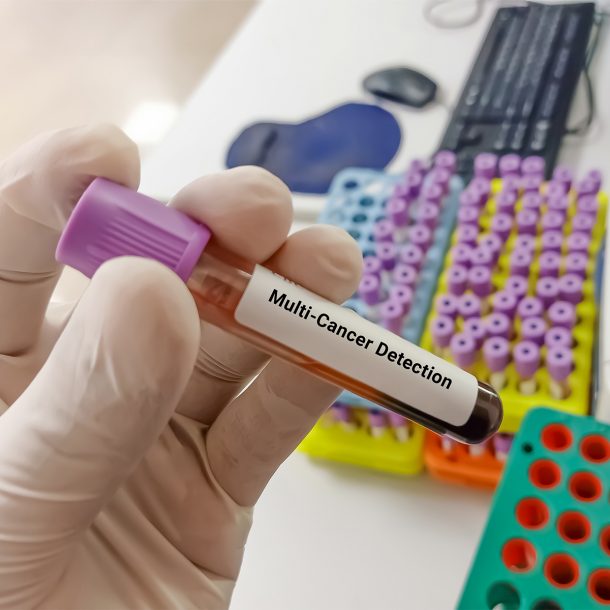
Of note, as part of the follow‑up study PATHFINDER 2, Grail presented a PPV of 61.6% at the European Society for Medical Oncology (ESMO) Congress in October 2025. For the purposes of our analyses here, we have used the data from the PATHFINDER study published in the Lancet in October 2023.
What Are the Benefits?
The mortality benefit remains uncertain until additional follow‑up is available. The maximum benefit would be to assume early mortality for the 35 cancers that Galleri found in a population of 6,621 people. This overstates the mortality benefit for several reasons:
- More than half of the cancers were Stage 3‑4. For those cases, the test would not have accelerated diagnosis by very much.
- Early stage at diagnosis does not always result in cure.
- Some cancers would not have progressed (clinically insignificant cancer or overdiagnosis).
- The insured population has lower prevalence of cancer compared to PATHFINDER, because of the increased risk characteristics. That means fewer cancers discovered on tests in the insured population.
- Testing below age 50 would further lower the prevalence.
Importantly, a life insurance carrier might derive ancillary benefits, such as increased customer satisfaction for the opportunity to screen for cancer, potentially resulting in improved persistency.
What Are the Costs?
PATHFINDER demonstrates that the number of tests to detect one cancer in this population is 189. At the price of $749 each, the cost of the tests alone would be $141,561. To detect one early-stage cancer requires 473 tests, which totals $357,277. A program will have additional financial costs for administration.
Beyond financial considerations, there are other costs associated with screening. Some of these items include:
- Positive results lead to a clinical workup to determine if cancer can be confirmed.
Most people had blood tests and imaging after a positive test. Among the false positives, 28% had non-surgical procedures and 2% had surgery. This adds up to considerable expense and some risk of morbidity or even mortality. Out-of-pocket cost could be substantial for the customer. - Another cost is the emotional cost for customers.
False positive results required a median of 162 days to reach a conclusion. The time stretched to nearly a year for some participants. That is a long time to suffer with anxiety. Anxiety does not even end with the workup, because some “false” positive results could be cancers that did not manifest within the one-year limit of the study.
What Else Might a Life Insurance Carrier Consider?
Face Amounts and Ages – The most financial benefit comes from larger policies and older issue ages where cancer prevalence is higher.
Excluding Customers – We have seen some companies express concerns over providing valueadded benefits only to certain groups of customers. There is a reputational risk with this decision that any insurance company should consider.
Re‑Test Decision – Each company will need to decide whether to offer the test again to customers in the future. Offering a re‑test too soon would reduce the number of cancers detected and may not make sense from a cost/benefit perspective. However, customers may come to expect or request additional testing in future years from their insurance company.
What Does the Future Hold For MCED Tests?
This is an exciting and rapidly evolving time for MCED test development and innovation. New tests, with performance trials that can be evaluated in a similar fashion as PATHFINDER, will likely become commercially available soon. Further observation will surely narrow the potential uncertainty regarding benefit, and future tests will undoubtedly improve and become more effective.
As additional information and data become available on Galleri (e.g., a published article on PATHFINDER 2 results), Cancerguard, and potential new entrants into the MCED testing space, the above analyses will be updated. Please reach out to a Gen Re representative for more information regarding MCED tests, or to start a discussion with one of our experts.
Endnote
- Lancet. 2023 Oct. 7;402(10409):1251–1260. doi: 10.1016/S0140-6736(23)01700-2